As the civilian death toll rises to 21, here’s a closer look at conflict in southwest Colombia.

Colombian armed group the Estado Mayor Central (EMC) has admitted its role in the massive roadside bomb near the small town of Cajibío that killed 21 civilians and injured 60 others in Cauca on April 25, the worst such attack in the country’s recent history.
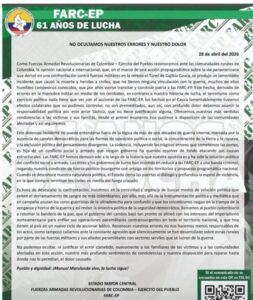
In a message, the EMC said “we cannot hide or justify the error” which resulted from buried explosives aimed at military targets but which they detonated in a queue of vehicles held at a roadblock.
See also: Dissident bomb kills 20 civilians at roadblock in southwest Colombia
Cajibío was one of 37 coordinated attacks over five days in Cauca and the neighboring Valle department, conflict analyst Gerson Arias of Fundacion Ideas para la Paz (FIP) told The Bogotá Post.
“This was a message of terror from the EMC who wanted to show their military superiority in the region,” he maintained.
And despite admitting its error, the EMC showed no signs of slowing its offensive in recent days. On Thursday police experts defused 600 kilos of explosives found wedged in a drainage tunnel near Piendamó, Cauca, potentially avoiding a fresh tragedy.
Civilian targets
Military sources told news media after the Cajibío bomb that the EMC fighters had likely set a trap on the Via Panamericana, the main route linking Cali and Popayán. They buried the massive bomb then forced trucks to block the highway before retreating to the wooded hillsides as a long queue of traffic formed on the busy road.
When troops arrived in their heavily armored tanquetas – fortified troop carriers with turret guns – they sensed a trap and parked several hundred meters from the blocked road, then moved on foot through the wooded hillside to engage the guerrillas.
An EMC fighter then remotely detonated the roadside bomb striking 15 civilian vehicles, killing 21 people and injuring 60. The combatants escaped in the aftermath.
Arias believes that despite their original plan to kill military targets, the EMC fighters chose to blow up civilian vehicles: “They decided to detonate; it was a decision by the EMC.”
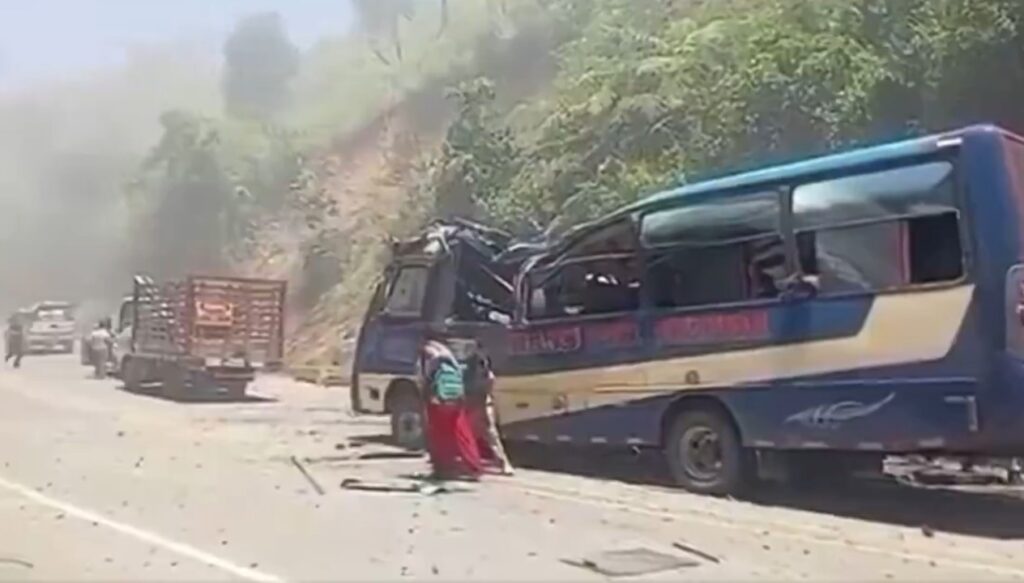
The resulting carnage was one of the highest civilian death tolls from a single incident in Colombian history, last seen on this scale in 2002 when a gas cylinder packed with high explosives detonated in a church in Bojayá, Chocó, killing 79 local people.
The deadly nature of homemade bombs, or ‘IEDs’ as they are called in military parlance (Improvised Explosive Devices), was shown again in August last year when 13 policemen were killed in Antioquia by a buried cylinder bomb that destroyed a helicopter.
Armed groups growing
Who was behind the Cajibío bomb? The EMC are remnants of the FARC’s 6th Front, formed by guerrillas that rejected the 2016 peace process, now called ‘disidencias’, or dissidents.
The EMC still uses the FARC name, uniforms and logo, and its leaders mimic the ideology of former FARC icons such as ‘Tirofijo’ insisting it is a “political insurgent force”.
Last week Colombia’s defense minister was swift to blame the EMC’s Frente Jaime Martínez which is under the command of alias Marlon, a former FARC commander freed from jail in 2016 as a signatory to the peace deal but who returned to the fray.
The Cauca-based Frente Jaime Martínez numbered around 600 combatants, one of the most powerful units in the Bloque Occidental of the EMC, explained Arias. FIP data showed the EMC numbering around 3,300 fighters spread across southern Colombia, an estimated growth of 23% during 2025. Around 60% of those were concentrated in southwest Colombia.
“Cauca is a strategic point for illicit mining and narcotrafficking, all the armed groups are seeking dominance, and this means intensive recruitment of young people into their ranks,” said Arias.
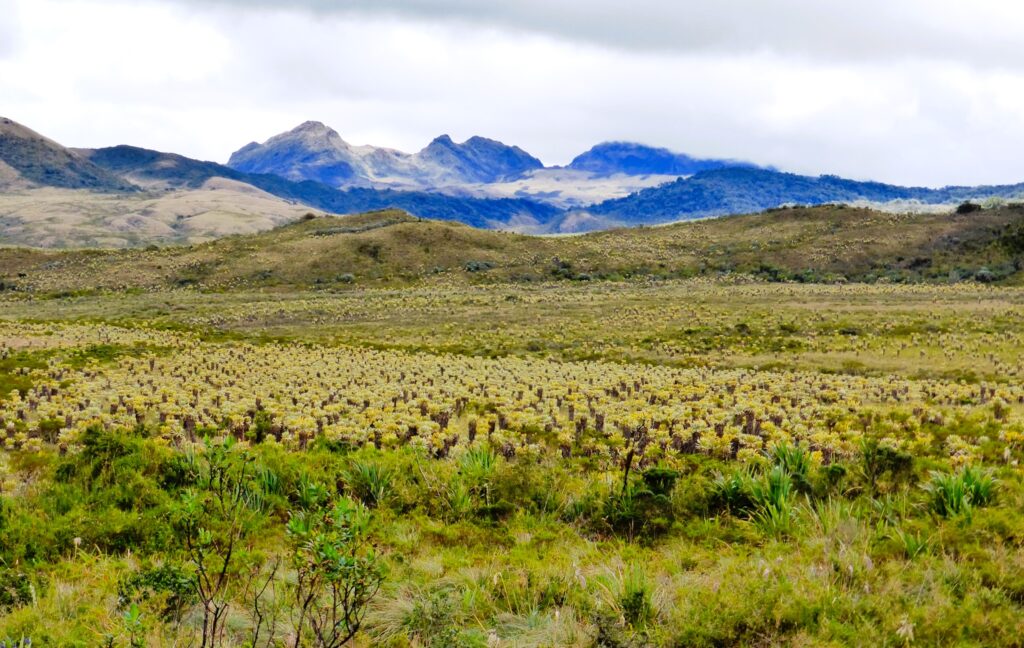
The mountainous department is a heartland of Colombia’s illicit economies, straddling both the Andean cordillera and the Pacific lowlands with topography perfect for both hiding rebel armies and providing lush hillsides for coca crops and marijuana.
Cocaine production needs large cropping areas, 32,000 hectares of coca bushes covered the Cauca hillsides by the last count (Indepaz, 2024). And since Spanish colonial times the lowland riverbeds have provided a source of gold, today mined illegally with destructive heavy machinery paid for by cocaine profits.
Inland links
Cauca has no proper roads linking the highlands coast, though there are numerous clandestine ‘conflict tracks’, mule trails and navigable rivers to the Pacific. A labyrinth of mangrove swamps provides cover for boats running an estimated 70% of Colombia’s cocaine product to central America and beyond.
The department’s east is formed by the ‘Cauca Boot’, a foot-shaped chunk of mountainous terrain long held by rebel groups which penetrates as far as the Caquetá jungle linking the eastern Llanos plains and Amazon region to the Pacific coast.
This corridor created a vital link between the interior of the country and the EMC’s Bloque Oriental, in the eastern plains and jungles, Arias told The Bogotá Post.

Cauca was also bisected by the Via Panamericana, the highway running down the mountain and linking three main cities – Cali, Popayán, Pasto – and on to Ecuador to the south. This neuralgic route was easily blocked or attacked by armed groups, he said.
Combat units like the Frente Jaime Martínez would likely have autonomy from the top leadership of the EMC and could plan and execute their own actions, explained Arias.
“They articulate and communicate with the EMC structure, but are not necessarily subordinate,” he said.
Failed peace plan
The EMC was originally included in Petro’s sweeping Paz Total (Total Peace) initiative in 2022, but after repeated infractions by the armed group – including murdering four indigenous children the group had forcibly recruited – talks broke down in 2024.
In October that year Petro called off the talks and ordered the military to attack EMC heartlands in Cauca. The ensuing Operation Perseus sparked intense combat around the town of El Plateado in the Micay Canyon, historically a hideout for the FARC and now an EMC stronghold.
FIP has been critical of Paz Total and in February this year published data showing that armed groups had used the façade of peace talks to expand both their ranks and territory.
See also: Peace plan has caused more conflict, says thinktank.
According to Arias, Petro’s government failed to understand the strategic importance Cauca had to the armed groups, as well as underestimating the control the EMC had over local communities.
Many rural families were reliant on coca growing and gold mining in a region lacking state presence: “There’s been a historical process of armed groups coopting civilian and ethnic communities,” said Arias.
This was evident in the civilian uprisings – asonadas – against state forces leading to incidents such as the 57 soldiers forcibly detained by a community in El Tambo in June 2025.
But the armed groups also preyed on the host population, he said, particularly victimizing the indigenous communities which make up 20% of Cauca’s population. EMC commanders frequently forced indigenous youth to join their ranks, creating conflict with the Nasa and Misak people of the area.
Contacts ofThe Bogotá Post living in rural Cauca – who declined to be named – said that armed groups controlled communities with networks of spies and even used surveillance drones to monitor movements.
A person needing to travel in or out of the zone controlled by a particular armed group needed permission and had to carry ID cards issued by community councils under orders of the armed group.
Anyone rejecting these restrictions was threatened and displaced, and particularly social leaders who spoke out against the armed groups risked being assassinated: 12 in Cauca so far in 2026.
The Cauca cauldron
Strength in numbers was a contributing factor to EMC aggression in the region, said Arias. FIP data showed a steady increase in armed attacks against both civilian structures and military targets since 2016, peaking at 175 recorded incidents last year (see graph below).
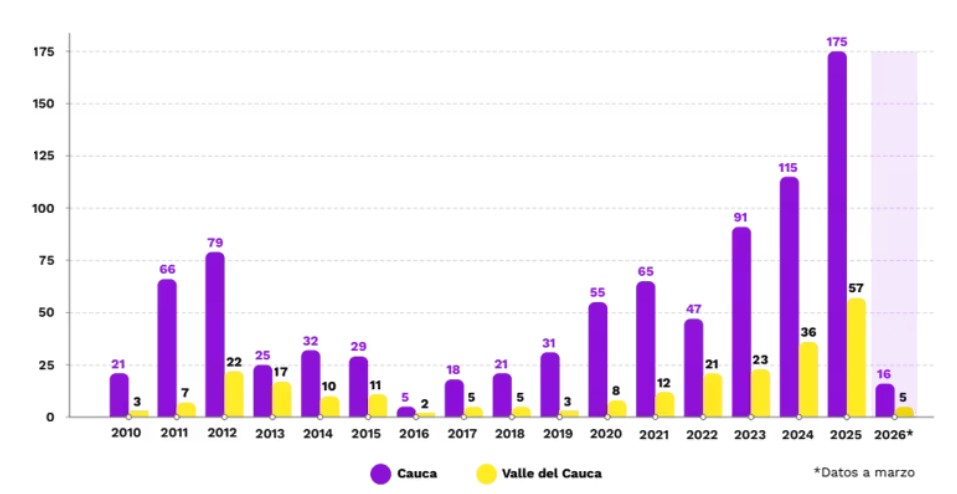
Not all events involved state forces; the EMC was under pressure from rival groups such as the ELN, Segunda Marquetalia and EMBF dissidents. All want a share of Cauca’s illicit economies.
And while waging a conflict of asymmetric warfare, often resorting to terror tactics, the EMC was also demonstrating military dominance with armed drones that put the Colombian military on the back foot.
“Out of 500 attacks, 408 were using drones,” said Arias. “The conflict is changing direction, but state strategies are not adapting to respond to this new technology.”
But beyond a military response, the state needed to implement a strategy of well-planned and sustainable social interventions to stem the resurgence of the armed groups.
In Cauca, this was a huge challenge, said Arias. For now, groups like the EMC were sticking to illicit gold and narcotrafficking, even if it meant constant conflict to deter and weaken state forces.
“They are on the attack to show they are the bosses,” he said.