Judges ordered the recapture this week of a Violeta Arango Ramírez, a prime suspect in the 2017 bombing of Bogotá’s Andino shopping mall, after she lost her legal protections as an ELN peace manager.
The Colombian attorney general’s office requested that Arango, thought to be active in the ranks of the ELN guerrillas, “be found immediately to comply with an order for prison detention” based on accusations she was a key participant in the attack that left three dead and 10 more injured.
Arango, a sociologist, was previously arrested in 2022, but then released from prison to assume the role of a gestora de paz (‘peace manager’) during peace talks between the ELN and the the Petro government.
The controversial release was criticised at the time by survivors and families of victims of the Andino attack as Arango remained a key suspect. By being nominated as a gestora de paz, Arango was allowed both her freedom and temporary avoidance of homicide and terrorism charges while whe was “collaborating with the peace process”.
This week’s recapture order followed breakdowns in government talks with the ELN with the Justice Department officially removing many combatants’ designations as peace managers. The news gave a glimmer of hope for justice after nine years of uncertainty as to who was behind the attack.
Arango herself has always denied any involvement in the attack, pointing to a plot from within the state prosecutors’ office to frame left-wing activists during the political fallout from the 2016 FARC peace deal.
Pamphlet bombs
The Andino attack unfolded during the evening of Saturday, June 17, 2017, inside the crowded women’s restroom of the busy shopping mall at a peak hour. It was the eve of Father’s Day.
A bomb placed in a toilet cubicle exploded killing one French and two Colombian citizens and maimed at least eight more women in or around the restroom.
Police investigators quickly blamed the Movimiento Revolucionario del Pueblo or MRP, a left-wing group that had evolved in Bogotá’s public universities and was dedicated to mediatic events such as dangling flags from buildings and letting off weak explosives that launched political leaflets into the air.
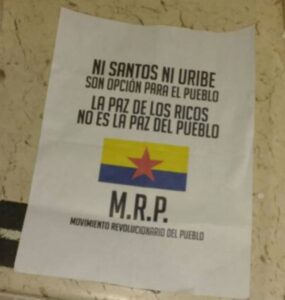
Over the space of two years the MRP had targeted public spaces outside tax offices, health insurers and banks with messages such as: “Today in Colombia the peace process is a business plan”, and “Health in Colombia is a problem of democracy”.
In the months following the attack, a dozen suspects accused of being linked to the MRP were rounded up, detained over many months, then tried and released after none of the evidence against them could be proven in court.
Meanwhile an alternative theory emerged: that the Andino bombing was part of a right-wing plot carried out to destabilise the then-Santos government’s closeness to left-wing guerrilla groups in the wake of the historic 2016 peace process with the FARC, previously Colombia’s most powerful armed group.
False positives
In this narrative, the MRP, with its history of small-scale attacks and rumoured links to the larger ELN guerrilla group, made a convenient scape-goat.
Investigators claimed to have found similarities between the Andino bomb and the pamphlet explosives, but an analysis by news website Las2Orillas at the time pointed out that the attorney general’s office at the time “had a long history of fabricating evidence” to bring down left-wing political targets, partly as a distraction from their own implications in high profile corruption cases.
Violeta Arango, an activist with links to left-wing causes, found herself officially accused of being an MRP leader and coordinator with the much larger ELN guerrilla group.
She avoided capture and publicy declared herself the victim of a “falso positivo”, or false positive, referring to the practice by the Colombian military of murdering civilians and disguising their bodies as guerrilla combatants.
“This legal persecution I am suffering, along with my family who are being harassed and abused, is nothing more than a setup by the police and the attorney general’s office,” she wrote in an open letter, before fleeing Bogotá.
What happened next is subject to speculation. According to Arango herself, she escaped into the arms of the ELN (literally, as she became the romantic partner of a senior commander) fearing for her life in the face of “political persecution”.
But her smooth transition into the ELN guerrilla’s Darío Ramírez Castro Front – active in the conflict zone of Sur de Bolívar – also seemed to vindicate the prosecution’s narrative of her links to urban terrorism.
Alias ‘Talibán’
Meanwhile in Bogotá, 10 other people were detained as suspected MRP members linked to the attack.
After searches of their homes, some were accused of carrying false IDs, carrying weapons, and, in some cases, having printed plans of the Andino shopping centre showing entrances and exits, and notes which appeared to show preparations for the bombing, and USB sticks with messages from the MRP.
But in many cases the police arrests and searches were themselves found to be illegal and without due process which, added to the flimsy evidence presented in court, lead to the the cases falling apart under legal scrutiny.
Some of these investigations were later examined in a documentary called Andino File: A Judicial Set-up? produced by journalism collective La Liga Contra el Silencio. One of the main accused, Iván Ramírez, described how the police produced CCTV used to identify him “scoping out the Andino”. This “evidence” later turned out to be video of a regular mall worker with a similar look.
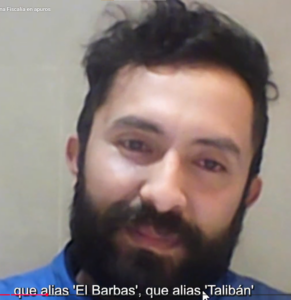
In another twist, Ramírez described how the police themselves invented the aliases to which the suspects were presented as a “terrorist cell” to the media; for example, ‘El Calvo’, ‘Japo’, ‘Aleja’ and, in the case of the bearded sociologist, ‘Talibán’. The scary name stuck and Ramírez was thereafter referred to by Colombia media as ‘alias Talíban’.
He was also constantly described by prosecutors as the “explosives expert” of the MRP cell, a charge he consistently denied.
Ramírez was released from custody in 2021 after spending four years in pre-trial detention, during which time every case against him collapsed. But even after his release he continued to be “linked to the investigation”.
Peace managing
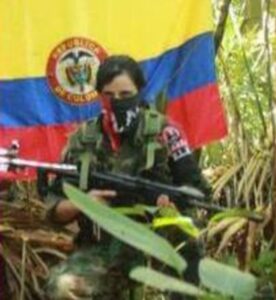
Then in June 2022, Violeta Arango, now in the ELN, was captured in the Sur de Bolívar in the same military operation that killed her partner, known as Pirry.
According to a post on X by the then minister of defence, Diego Molano, alias Pirry was “one of the top ELN commanders responsible for attacks on the civilian population, forced recruitment, and terrorism”.
Arango was jailed for her guerrilla links even while the process continued against her for the Andino bombing.
That panorama changed when Petro Gustavo took the presidency in August 2022; with peace talks in the air, and after a visit from a Cuban and Norwegian delegation to her jail, Arango was released to her gestora de paz role in November that year. She resurfaced a month later in Caracas, Venezuela, as part of the ELN talks with the Petro government.
This appearance caused anger among the Andino victims. Pilar Molano, who lost a leg in the explosion, told Vorágine magazine that “it’s insane that they let her out and put her in the peace negotiations with the ELN”.
Six years after the Andino attack, in April 2023, the prosecutor’s office again filed charges against Arango based on evidence that prior to the bombing she had downloaded plans of the shopping mall from the Internet.
Cell structures
The indictment formally accused Arango of the “detailed planning” of the bomb attack. It further alleged that Arango was a senior member of the MRP “responible for attracting new members to the criminal organization in Bogotá and apparently participated in at least 21 terrorist attacks against EPS headquarters, public transport and infrastructure”.
With this week’s recapture order the case can move ahead – assuming she can be found.
Any trial could shed light on the who and why of the Andino bombing, and also the complex backstory of ‘Violeta’. But, given the shambolic history of the judicial process, it could also put the investigation back to square one.
In interviews in the intervening years leaders of MRP have repeatedly denied their groups involvement, as well as denying any links to the ELN, or any connections to the original suspects.
But the truth might be hard to find even within the two armed groups; both the ELN and the MRP are known to work in cell structures which plan autonomous actions often without the co-members or leaders aware.
Such was the case with the devastating car bomb that killed 20 young police recruits in Bogotá in 2019, initially denied by the ELN – their leadership claimed not to know of the plot – but eventually taking responsibility.
An unusual element of the Andino bombing is that no armed group or political movement has ever taken responsibility. And so far the prosecutors have not only failed to pin the attack on the MRP, but also ignored alternative lines of investigations such as a false flag operation by paramilitary or right-wing groups.
Lawyer for the Andino victims and survivors Franciso Bernate, said this week that “on behalf of the 11 female victims we hope Violeta is found so she can respond to these grave accusations”.